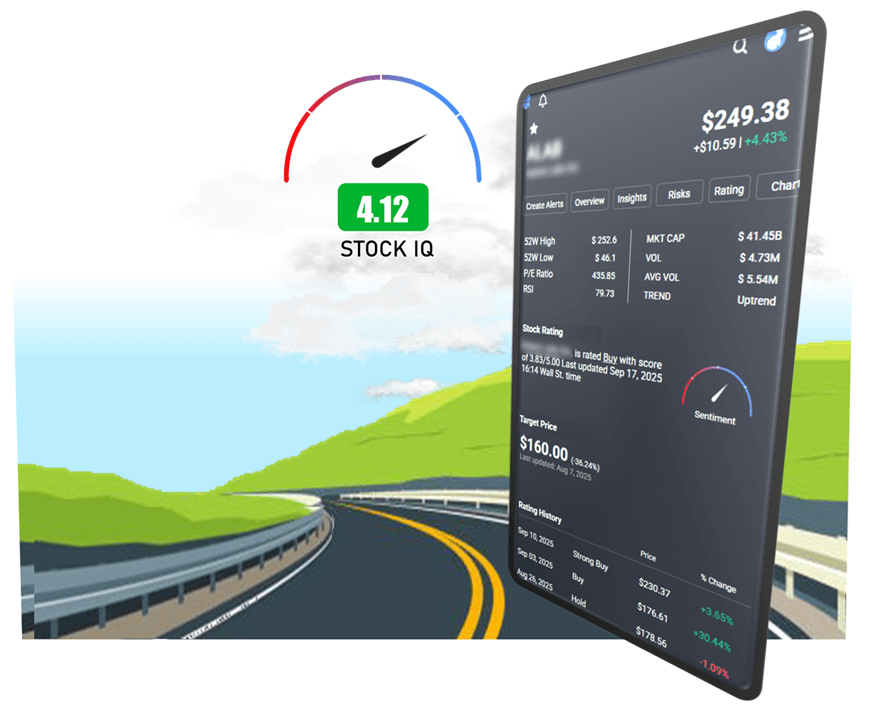
Find new investment opportunities based on Market Sentiment Indicator. Manage watchlist risk with leading indicator of volatility See what influential analysts and investors are saying about stocks in My Watchlist
Most Trending
-14.44%
+22.49%
+0.48%
+12.65%
+2.37%
Most Trending
-14.44%
+22.49%
+0.48%
+12.65%
+2.37%
06 Dec 2025So let me get this straight. The company that was left for dead just two years ago, the one where everyone had written the obituary, just got invited to sit at the big kids table. $CVNA is joining the S&P 500 on December 22nd, and the stock popped nearly 10% after hours because that's what happens when you tell passive fund managers, they have no choice but to buy something. The algorithm says buy, so you buy. Democracy dies in passive investing.
S&P Dow Jones Indices announced the reshuffle on Friday, with Carvana entering alongside $CRH and Comfort Systems USA. Moving out are $LKQ, Solstice Advanced Materials and $MHK, which is what happens when you slip below the line. The S&P 500 is not sentimental. You stop being big enough or profitable enough, you're out. Doesn't matter if you've been there for decades.
But here's where it gets interesting. Carvana was actually dead. Not "struggling" dead. The kind of dead where serious questions hung over whether the company would survive at all. Debt had ballooned, operational costs were spiraling, and their famous car vending machines looked less like innovation and more like very expensive sculptures. What nobody expected was that management would actually fix it and fix it fast.
They cut costs aggressively, streamlined operations, improved cash flow, and doubled down on the online platform that made them famous in the first place. The company that seemed destined to become a cautionary tale about growth-at-any-cost started posting real improvements. And they did it quickly enough that the turnaround happened before most investors finished processing it. One minute you're reading about survival concerns, the next minute they're calculating passive fund inflows.
The irony is delicious. $CVNA built its brand on disrupting the used car business with a fully digital platform where customers can browse, finance, trade in, and complete purchases online, sometimes through automated vending machines. The whole pitch was trust us, we're different, we're better. Then they almost died specifically because they spent too much money on disruption and not enough time on boring things like unit economics. They disrupted themselves right to the edge.
Now they're joining the index that represents American corporate stability. The S&P 500 is supposed to be boring. Companies that will definitely exist next year, probably exist in ten years. Putting Carvana in there feels like inviting the reformed bad boy to Thanksgiving dinner. Sure, he's got a job now, but everyone's still watching carefully.
Here's what's really happening beneath the surface. The market is telling us something about what it values right now. It's rewarding companies that nearly died but figured out how to not die. Survival is the new innovation. Carvana didn't invent anything revolutionary in the last two years. They just stopped bleeding money and started making some. That's it. And for that, they get promoted to the most important index in the world.
Think about what that says. The bar for impressing Wall Street isn't "change the world" anymore. It's "show me you understand how to run a business." We've come full circle from when profitability was for suckers and growth was everything. Now profitable is sexy again. Who knew accounting could be romantic?
Getting into the S&P 500 is not easy. You need market cap typically above 18 to 20 billion dollars. Positive cumulative earnings over the last four quarters, including the most recent one. Substantial free float to ensure real tradability. Majority US operations and incorporation. At least half of shares held by public investors. The committee also evaluates business model sustainability, financial reporting quality, and operational risk. The index formally rebalances four times per year, so each change is significant and moves hundreds of billions across passive funds.
The mechanical part is simple. Passive funds tracking the S&P 500 need to own $CVNA now, so they buy it. That creates demand regardless of whether anyone thinks the stock is worth its current price. It's forced buying, which is the best kind if you're already holding shares. For the next two weeks, every index fund manager is doing math on their allocations and trying to buy without moving the market too much. Spoiler: they will move the market. They always do.
But the more interesting question is what happens after the inclusion. Once the mechanical buying is done, what then? Does $CVNA keep climbing because the business is legitimately good now? Does it plateau because the good news is priced in? Or does it drop because traders who rode the wave take profits? Nobody knows, which is what makes markets fun.
What we do know is that Carvana executed one of the more impressive turnarounds in recent memory. They faced serious existential problems and solved them. They were left for dead and came back anyway. They turned a business drowning in debt into something stable enough to meet S&P's strict criteria. That's not luck. That's competence under pressure.
The real lesson here isn't about Carvana specifically. It's about what markets reward and when they change their minds about what matters. For years, markets rewarded growth at any cost. Revenue growth, user growth, market share growth. Profitability was something you worried about later. That strategy worked great until it didn't, and when it stopped working, it stopped very suddenly.
Now we're in a different regime. Markets want profitable growth. They want companies that understand unit economics. They want management teams that know when to stop spending on dreams and start making money on reality. Carvana figured that out just in time. Some of their peers didn't, and those companies are either gone or barely alive.
For traders, the setup is clear. You've got forced buying from passive funds, momentum from the after-hours pop, and a narrative that resonates. That's usually enough to push a stock higher short term. Whether it stays there depends on execution and market conditions.
For longer-term investors, the question is whether this is a company you want to own after the inclusion dust settles. Has the business model proven durable? Can they maintain profitability through different economic environments? Do they have competitive advantages worth defending? These questions matter more than the index mechanics.
But let's be honest. Most people want to know if the stock goes up. The answer is probably yes short term because of mechanical buying, maybe yes medium term if the business stays healthy, and who knows long term because that's what makes markets interesting.
What makes this story worth attention is the reminder that markets are dynamic. Companies that look dead can come back. Business models that seem broken can be fixed. Management teams can learn and adapt. And sometimes, the consensus is wrong.
The consensus on $CVNA was that it was doomed. The company was burning cash, drowning in debt, operating in a market turning against them. The stock traded like it was over. And then it wasn't. The company fixed itself, the stock recovered, and now they're joining the S&P 500. That's not supposed to happen, except it just did.
So when you see that 10% after-hours pop on index inclusion news, you're not just watching mechanical fund flows. You're watching the market acknowledge that it got the story wrong, or at least that the story changed faster than expected. That's worth remembering the next time everyone agrees something is obviously terrible or obviously great. The obvious trade is usually the crowded trade, and the crowded trade usually hurts.
If you want to dig deeper into whether the current valuation makes sense or if there's room to run, that's worth exploring before the December 22nd inclusion date arrives. For now, just appreciate the absurdity of watching a company go from near-death to S&P 500 inclusion in roughly two years. That's either inspiring or terrifying, depending on whether you owned it on the way up.
10:26 AM
Yesterday at 10:06
Yesterday at 03:23
Yesterday at 03:21
Join StocksRunner.com for daily market updates, expert analyses, and actionable insights.
Signup now for FREE and stay ahead of the market curve!
Find out what 10,000+ subscribers already know.
Real-time insights for informed decisions.
Limited slots available, SignUp Now!
Please note that the content above should not be considered as investment advice or marketing. It does not take into account the personal data and requirements of any individual. This content is not a substitute for the reader's own judgment and should not be considered as advice or a recommendation for buying or selling any securities or financial products.
Get all the pieces of the puzzle on important data activity before the major news sources break the story and find out what happening right now and what could happen in the future
Join over 10,000+ subscribers who value exclusive insights. Stay ahead in the stock market! Enter your email for daily alerts
Real-time stock market updates
Expert stock analysis
Investment strategies
Top stock recommendations
Trading signals and opportunities
Discover what is happening right now and piece together the key data activity before the major news outlets catch on. Stay ahead of the trends
FIND US ON
Unlock the knowledge that 10,000+ subscribers already cherish. Join for exclusive insights and stay ahead in the stock game! Enter your email to receive daily alerts
In-depth stock analysis
Informed investment decisions
Stock market insights
Stock trading tips
Disclaimer:
The Score performance whether actual or indicated by historical tests of strategies, is no guarantee of future performance or success. The results reflect performance of a strategy not historically offered to investors and does not represent returns that any investor actually attained.
The results reflect performance of a strategy not historically offered to investors and does not represent returns that any investor actually attained. The Readiness Indicators, Sentiment Indicators and total score are calculated by the retroactive application of a model constructed on the basis of historical data and based on assumptions integral to the model which may or may not be testable and are subject to losses. Active trading is generally not appropriate for someone of limited resources, limited invesment or trading experience, or low-risk tolerance. Your capital may be at risk.
Please note that no offer or solicitation to buy or sell securities, securities derivatives of future products of any kind, or any type of trading or invesment advise, recommendation or strategy, is made, given or endorsed by StocksRunner including any of their affiliates ("TS").
This information is provided for illustrative purposes only. You should not rely on any advice and/or information contained in this website and before making any investment decision. we recommend that you consider whether it is appropriate for your situation and seek appropriate financial, taxation and legal advice.